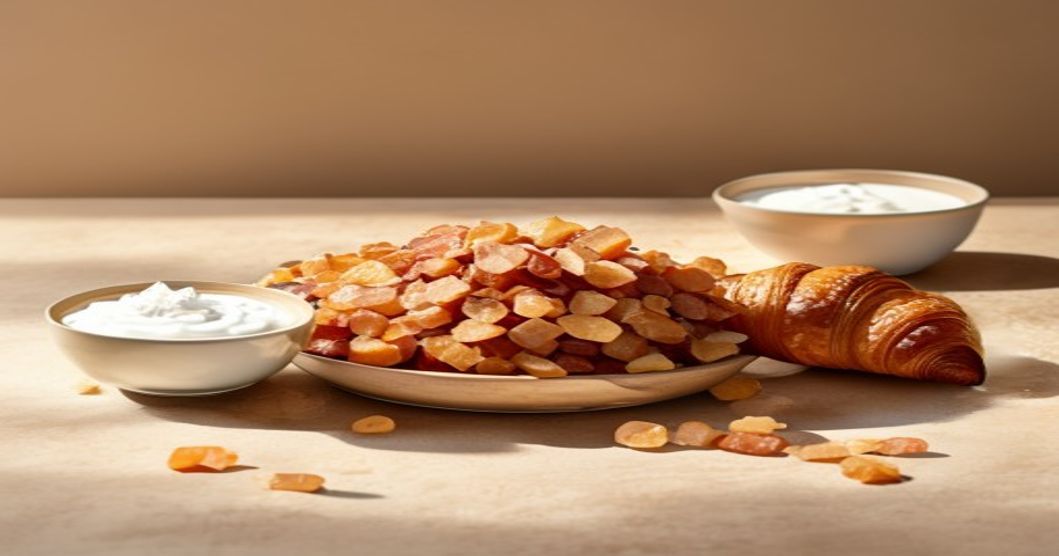
A cereal line, a muffin batter and a yoghurt fruit-prep all use "dried apricot" — and all three would fail on the wrong particle. The cereal wants a free-flowing granule that meters through a volumetric doser; the muffin wants a soft dice that survives mixing without smearing; the yoghurt wants a piece small enough to sit on a spoon but large enough to read as fruit. Whole dried fruit is a commodity. Cut, diced and granulated fruit is an ingredient with a specification, and that specification is where most sourcing conversations either succeed or quietly go wrong. This guide explains how to write it, what formats exist, and how a producer that dries fruit geothermally in Sındırgı and cuts it to order actually executes against it.
If you are new to the broader private-label dried fruit conversation — who does what, what documents travel with the goods, and how packing fits in — start with the private label dried fruit manufacturer guide and come back here for the cutting side.
Why particle spec decides whether an ingredient works
Four things happen on a production line that whole fruit does not care about and cut fruit absolutely does.
Dosing. Volumetric and gravimetric feeders assume a consistent bulk density and a piece size that does not bridge in the hopper. A 6–8 mm dice behaves predictably; a lot with 20 percent of pieces above 12 mm blocks the throat and starves the line intermittently, which shows up as under-dosed product and a quality complaint that nobody traces back to the fruit.
Mouthfeel. In a granola cluster, a 3 mm granule reads as texture; an 8 mm dice reads as a bite. Neither is wrong, but the sensory panel that approved your product approved one of them, so the second must not arrive as a "close enough" substitution.
Mixing. Soft, high-sugar fruits (fig, date, apricot) deform under shear. A dice that is too small has too much cut surface relative to its volume, releases sugar and smears through a batter; a dice with the right size-to-surface ratio stays discrete. This is why bakery specs care about tolerance, not just nominal size.
Flow. Cut fruit exposes sticky interior. Without a flow aid the pieces re-agglomerate in the bag during transit, and what left the plant as free-flowing dice arrives as a block. The spec must therefore state whether an anti-caking approach is permitted, and which.
Formats: what "cut to spec" actually covers
Our cutting programme sits downstream of geothermal drying at the Sındırgı facility. The dried fruit is sorted, then routed to the format the order calls for. In practice, the formats buyers specify are:
- Slices — apple, pear, quince, banana-style rings or lateral slices, defined by thickness and, where relevant, whether the core or stone cavity is retained.
- Dices (cubes) — the workhorse for bakery, cereal and dairy. Specified as a nominal edge length with a range (for example 6–8 mm or 8–12 mm) rather than a single number, because natural fruit does not cut to a machined tolerance.
- Granules — smaller than dice, typically produced from firmer or lower-moisture fruit, defined by a sieve range (for example 2–4 mm) so both the top and bottom fraction are controlled.
- Flakes — thin, irregular pieces used where visual coverage matters more than geometric shape (cereal toppings, bar surfaces).
- Powder — the finest end of the same stream, milled and sieved. It follows different rules and has its own guide: fruit powder and purée contract manufacturing.
The table below summarises what buyers typically ask for and which spec parameters actually control the outcome.
| Format | Typical size range | Typical application | Spec parameters that matter |
|---|---|---|---|
| Slices / rings | 2–8 mm thickness | Snack packs, cereal toppings, décor | Thickness range, diameter min/max, moisture, colour retention |
| Large dice | 8–12 mm edge | Muffins, cakes, bread inclusions, trail mix | Nominal edge + tolerance, % over/undersize, moisture, aw, coating |
| Small dice | 4–8 mm edge | Yoghurt fruit-prep, ice cream, granola clusters | Edge range, fines %, aw, coating, sugar smear behaviour |
| Granules | 1–4 mm sieve fraction | Cereal flakes, bars, seasoning blends, tea blends | Sieve pass/retain, bulk density, moisture, flow aid |
| Flakes | Thin, irregular, 5–15 mm | Cereal surfaces, bar tops, visual inclusion | Thickness, colour, breakage tolerance |
| Powder | Mesh-defined | Smoothie mixes, supplements, bakery colour/flavour | Mesh range, moisture, hygroscopicity — see powder guide |
None of these ranges is a promise for a specific fruit; a soft fig and a firm apple do not cut identically, which is why the spec sheet and a sample come before the purchase order.
How to write a cutting spec sheet that a plant can execute
A useful spec is one the operator can act on and the QC lab can measure. Here is what to include, in the order a plant reads it.
- Fruit, variety and treatment. "Dried apricot, unsulphured" or "dried fig, natural, no added sugar". Treatment matters for cutting behaviour: sulphured apricot is typically firmer than unsulphured. If sulphites are in play, the label consequences are covered in our sulphites and sorbates labelling guide.
- Format and nominal size. State the format and a range: "dice, 6–8 mm". A single number invites disagreement about what counts as compliant.
- Tolerance. Express as a maximum share of the lot outside the range, e.g., "≤10 percent oversize, ≤5 percent fines below 2 mm". Fines are the fraction that shows up as sugary dust and are the most common source of complaints.
- Moisture and water activity. Cut fruit exposes interior, so moisture must be set to the application: lower for cereal, higher where softness matters. State a moisture range and, where the host product is shelf-stable, a water activity ceiling. Both are CoA parameters — see how to read a dried fruit CoA.
- Anti-caking approach. State one of three positions: no flow aid permitted; a food-grade natural coating acceptable (rice flour and similar starch or fibre-based coatings exist as options, and each becomes an ingredient that must appear on the finished-product label under Regulation (EU) No 1169/2011); or a specific coating required with a maximum inclusion level. Do not leave this blank — the plant will otherwise ask, and the delay lands on your timeline.
- Colour and defects. Acceptable colour range and maximum share of dark or blemished pieces, ideally against a reference photo agreed at sample stage.
- Foreign matter and physical hazards. Stone fragments in stone fruit are the specific risk in dicing; state your detection expectation (metal detection is standard; other requirements should be written down).
- Microbiological and contaminant limits. Reference the EU limits your product must meet rather than inventing tighter ones you cannot justify — the plant will test to what you specify.
- Packaging and lot identity. Inner liner, carton or bag size, and the lot-coding format you need for your own traceability, which under EU rules must connect every batch back to a supplier lot — the mechanics are in our EU food traceability and lot tracking guide.
A one-page spec written this way is faster to quote, faster to sample against, and dramatically less likely to produce a "but that is what we always ship" conversation later.
Inclusions for dairy and bakery: the demanding end of the range
Inclusions are cut fruit engineered to survive a hostile matrix — batter at 180 °C, ice cream at −18 °C, or a fermented yoghurt base with its own water activity. The size and moisture rules above still apply, but two more variables enter: water migration (a piece that is wetter than the surrounding matrix will pull or push water and either dry out or soften the product around it) and thermal behaviour (high-sugar dice can scorch on a tray edge or sink in a light batter). We cover the application-specific detail — bake stability, freeze stability, piece sizing per host product — in the dedicated fruit inclusions supplier guide for dairy and bakery. For a cutting order, the practical implication is simply that inclusion specs should name the host product, because "6–8 mm apricot dice for muffins" and "6–8 mm apricot dice for stirred yoghurt" may end up at different moisture targets and different coating decisions.
Quality checks that happen at the plant
Cutting adds process steps, and each one is a control point under the ISO 22000 food-safety management system that Arovela operates alongside ISO 9001 and ISO 27001. What a buyer should expect to see, or be able to ask for, on a cut-fruit lot:
- Incoming fruit qualification. Moisture and visual grade of the dried fruit before cutting; a soft, over-moist lot cuts badly and is rejected at this stage rather than downstream.
- Size verification. Sieve or calliper checks at defined intervals during the run, recorded per lot, so the tolerance you specified is a measured number rather than an operator's impression.
- Fines and oversize separation. Screening after cutting to remove the fractions outside spec; those fractions are diverted, not blended back to reach a target.
- Metal detection. Standard on cut product; the sensitivity setting is a spec item if your customer audit requires it.
- Coating control. Where a flow aid is applied, the addition rate is recorded because it is a labelling matter as well as a functional one.
- Lot documentation. Certificate of Analysis for the lot covering the parameters your spec named — moisture, aw, size distribution, micro, contaminants as applicable — with the batch number that appears on the outer packaging.
Certifications at company level are ISO 22000, ISO 9001 and ISO 27001. Some retail and manufacturing customers ask for additional scheme audits as their own market requirement; if a document is not in that list, ask rather than assume — we would rather answer the question at quote stage than at audit stage.
Sampling: the step that saves the most money
Because natural fruit varies by season and variety, and cutting behaviour follows the fruit, the honest sequence is sample first, commit second. A practical sampling protocol:
- Send the draft spec, and receive a sample cut from a real dried-fruit lot, not a showcase piece.
- Run it on your line at the intended dose. Hopper flow, smearing in the mixer and behaviour after bake or freeze are things a lab bench does not reveal.
- Sieve a portion yourself and compare the size distribution to the tolerance you wrote. Adjust the spec if your line is happier with something slightly different — this is the moment to do so.
- Confirm packaging and lot-code format against the sample carton.
- Only then place the first production order.
Colleagues who buy finished snack products rather than ingredients often ask how quickly a full retail programme moves once specs are settled; the 60-day private label snack production overview describes that timeline. For cutting-only ingredient orders the calendar depends on the fruit's seasonal availability, the format and the volume, and is confirmed with the quote.
What Arovela does — and what you supply
Scope options for cut fruit follow the same logic as our other contract work:
- Full service. Fruit from Arovela's own geothermally dried range at Sındırgı, cut, screened, coated (if specified), packed and documented.
- Processing of customer-supplied fruit. You ship qualified dried fruit; we cut, screen and pack to your spec. Incoming qualification still applies.
- Retail-ready output. Where the cut fruit is a finished product rather than an ingredient, it can move directly into retail packaging; the pouch side is covered in the doypack and retail packaging guide, and the trade-off between buying wholesale versus building your own label is discussed in wholesale vs private label: which model.
Delivery to EU customers can route via our Solingen, Germany warehouse for buyers who want goods already in free circulation; direct shipment from Türkiye remains the default for larger consolidated volumes.
FAQ
What minimum order applies to cut, diced or granulated dried fruit?
It depends on the fruit, the format and whether the fruit comes from our range or is customer-supplied. Small dice from a fruit we hold in stock is a different proposition from a rare format cut from customer material. State the fruit, format, target volume and delivery country in your inquiry and the quote will carry a concrete minimum and lead time.
Can you cut sulphured and unsulphured fruit to the same size spec?
Usually yes, but not to identical tolerances, because firmness differs. Unsulphured apricot, for example, is softer and produces a slightly higher fines share at the same nominal size. We flag this at sample stage so the tolerance you write reflects the fruit you actually chose.
Which anti-caking options are available for cut fruit?
Options range from no coating at all (with the flow trade-off that implies) to food-grade natural coatings such as rice flour or other starch or fibre-based materials. Each has a labelling consequence under EU rules, so the coating decision is made together with your label. We do not apply anything the spec does not authorise.
What documents accompany a cut-fruit lot?
A Certificate of Analysis for the parameters your spec names, lot number on every outer pack, and the standard commercial documents. Company-level certifications are ISO 22000, ISO 9001 and ISO 27001; anything beyond that should be requested at quote stage so we can confirm what is available for the specific product.
How is the price set for custom cutting?
By fruit, format, tolerance tightness, coating, packaging and volume — a tight tolerance with a low fines allowance costs more than a wide one because more material is screened out. There is no meaningful list price; a specific quote against a specific spec is the only honest number.
Ready to turn a nominal size into a working ingredient? Send your draft spec — fruit, format, size range, tolerance, moisture target and coating position — and request a quote; we will come back with a sample proposal and commercial terms together.