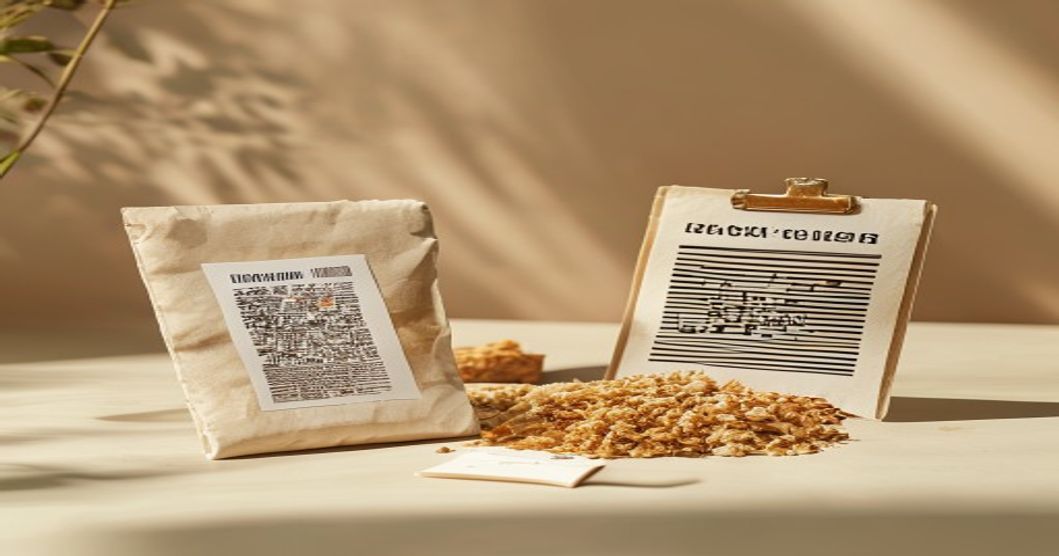
A tea bag becomes a product the moment it goes into a box with a label, and that box is where most private label programs lose time. The blend is approved, the bag format is chosen, and then the launch slips three weeks because the ingredient list is in the wrong language, the net quantity is missing, or the barcode was generated from a free online tool and rejected at listing. This guide sets out what a retail-ready tea package consists of, which label elements are mandatory in the EU and why, and — for brands working with Arovela — exactly which parts of that work we do and which parts only the brand owner can do.
It is written for tea and herbal infusion brands selling in the EU through e-commerce, independent retail or supermarket private label. If you have not yet settled the bag format itself, start with the tea bag types guide; the packaging decisions below assume that choice has been made.
Outer box formats: what the shelf actually sees
For tea bags, the outer pack is doing three jobs at once — protecting aroma, carrying the legal label, and selling the product — and each box format balances those jobs differently.
Printed folding carton. The standard for supermarket and most e-commerce tea: a board carton, printed in full colour, typically holding 15, 20 or 25 bags. It is the cheapest format per unit, prints well, stacks efficiently on pallets and on shelves, and gives generous space for the mandatory particulars. Its weakness is barrier — a plain carton does very little for aroma retention, so it is normally paired with an inner wrap.
Rigid or premium box. A heavier board or two-piece construction, often with an inner tray to hold individually enveloped bags upright. It photographs well for D2C listings and gift positioning, costs materially more, and takes longer to make. Brands sometimes choose it for a launch when a well-printed folding carton would have done the same commercial job at lower risk.
Tin. Reusable and strongly premium, with excellent barrier. Print is by direct decoration or an applied label, unit cost is high, and minimum print runs from tin suppliers can exceed the tea-bag order itself. Usually a second-phase decision, not a first-order one.
Stand-up pouch. Common for loose-leaf and increasingly for pyramid or enveloped bags sold online. Good barrier, low weight, but a smaller and less structured print surface — plan the legal panel early, because the space runs out faster than on a carton.
Retail-ready secondary packaging. For supermarket listings, the outer case (usually 6 or 12 retail units) is often required as a shelf-ready tray with a perforated tear-off front so store staff can put it straight on the shelf. This is a specification the retailer sets, and it needs to be known before the carton dimensions are frozen. The supermarket private label supplier guide covers what buyers in that channel typically ask for.
Inner wrap: the part the customer never photographs
Inner packaging is where aroma is actually protected. Options run from a single inner liner bag around the whole stack of tea bags, to individually enveloped bags in paper or a paper-film laminate. Individual envelopes give the best per-bag freshness and a premium unboxing, at higher cost; a single inner liner is economical and adequate for fast-turnover SKUs. If you are choosing between them, decide on the basis of expected time-to-consumption — a 20-bag box that sits in a kitchen for two months benefits from envelopes far more than one used up in a fortnight.
Enveloped bags are one of the three formats Arovela produces alongside single-chamber flat bags and string-and-tag bags. Where a brand wants an inner liner rather than envelopes, that is specified with the box.
Mandatory label elements under EU FIC Regulation 1169/2011
The rules for what must appear on a prepacked food label in the EU are set by the Food Information to Consumers Regulation (EU) No 1169/2011 (FIC). Tea and herbal infusions are foods for these purposes, and the mandatory particulars apply to every retail unit. The table below lists the elements a tea box needs, whether each is mandatory, and the mistake we see most often on incoming artwork.
| Label element | Mandatory? | Common mistake |
|---|---|---|
| Name of the food (legal or descriptive name) | Yes | Fanciful brand name only ("Evening Calm") with no descriptive name such as "herbal infusion with linden and lemon balm" |
| List of ingredients, descending order by weight | Yes (single-ingredient products may be exempt) | Percentages missing where an ingredient is emphasised in name or image (QUID); flavourings not declared correctly |
| Allergen emphasis within the ingredient list | Yes | Allergens listed in a separate box only, instead of emphasised (e.g. bold) inside the list; "may contain" used as a substitute |
| Net quantity | Yes | Bag count given instead of net weight in grams; weight of packaging included |
| Date of minimum durability ("best before") | Yes | Format that does not name the location on pack ("see base"); day omitted for products with less than three months' durability |
| Lot or batch identification | Yes, unless the date shows day and month uncoded | No lot code and a "best before end" that gives month and year only |
| Special storage conditions | Yes, where needed | Missing entirely on herbal blends that lose aroma in humidity |
| Name or business name and address of the responsible food business operator | Yes | Manufacturer's address used instead of the brand owner's; non-EU address with no EU importer named |
| Country of origin or place of provenance | Where omission would mislead | Flag or "EU brand" cues on a Turkish-origin blend without a provenance statement |
| Nutrition declaration | Generally exempt for herbal and fruit infusions without nutritionally relevant added ingredients | Copy-pasting a nutrition table from an unrelated product; or omitting it on a blend with added sugar or candied fruit |
| Minimum font size (x-height 1.2 mm; 0.9 mm on very small packs) | Yes | Legal panel shrunk to fit design; ingredient list below the threshold |
| Language of the member state of sale | Yes | English-only label sold in Germany or France |
Two of these deserve a closer look because they cause the most re-prints.
Allergen emphasis. FIC requires substances listed in Annex II (cereals containing gluten, nuts, milk, soya, sulphites above 10 mg/kg and so on) to be emphasised typographically within the ingredient list itself. Most herbal infusions contain none of them, and the temptation is to skip the topic. Do not: blends with barley, roasted almond pieces or certain fruit preparations can bring an allergen in, and blends packed on lines that also handle allergen-containing products need a considered "may contain" decision. The ingredient list Arovela supplies with each approved recipe identifies any Annex II substances so that your designer can apply the emphasis correctly.
Lot identification and the date. The lot rule comes from Directive 2011/91/EU: a lot mark is mandatory unless the best-before date already shows day and month in uncoded form. Most tea brands print a "best before end MM/YYYY" — which means the lot code is required alongside it. Arovela applies the lot code and best-before at packing; the artwork simply needs to leave a clearly marked print area for them. How that lot number then travels through your own records is the subject of the EU food traceability guide.
Language requirements across member states
FIC Article 15 requires mandatory particulars in a language easily understood by consumers in the member state where the product is sold, and allows member states to require their official language. In practice: German for Germany and Austria, French for France, Italian for Italy, Spanish for Spain, Dutch and French for Belgium, and so on. Multi-language legal panels are the standard solution for pan-EU e-commerce, and a folding carton comfortably holds four to six languages if the panel is planned from the start.
Language is also where brands most often try to save money by "just doing English first". For an EU launch, that produces a product that is technically non-compliant in most of the markets it will ship to. Decide your launch markets, list the required languages, and build the panel once. If you sell through Amazon's pan-European programme, the marketplace's own listing rules will also expect the label to match the destination country.
Some member states add national environmental or sorting labels on packaging (France's sorting logo scheme is the best-known example). These are packaging-law requirements rather than food-label ones, but they occupy the same panel and need to be on the artwork brief.
Claims: name your blend, do not prescribe it
Tea and herbal infusion marketing is full of language that the EU treats as a health claim. "Detox", "supports immunity", "helps you sleep", "aids digestion" — each of these is a claim about a relationship between the food and health, and under Regulation (EC) No 1924/2006 health claims may only be used if they are authorised for the specific substance. Many botanical claims remain in a pending status, and general wellbeing statements are only permitted alongside an authorised specific claim. Separately, FIC prohibits attributing to any food the property of preventing, treating or curing disease.
The practical route most compliant brands take is descriptive rather than therapeutic: "Evening blend with linden and chamomile", "Digestive blend with mint and fennel". The ingredients say the rest, and the product name does not become a regulatory liability. Bring your intended front-of-pack wording into the artwork brief early; it is far cheaper to adjust a name before print than after.
Barcode and GTIN
Retail and marketplaces identify products by a GTIN, printed as an EAN-13 barcode on the retail unit. Three rules save the most trouble:
- License your GTINs from GS1 (national member organisation) rather than buying resold or recycled numbers; marketplaces increasingly verify that the GTIN's registered brand owner matches the listing.
- One GTIN per sellable variant — every blend, bag count and pack size that a checkout has to distinguish needs its own number. A 20-bag and a 40-bag box of the same blend are two GTINs.
- Respect quiet zones and print quality. The barcode needs its clear margins, adequate size and enough contrast; dark ink on a light background scans, metallic or reversed-out designs often do not. Retail case packs typically carry a separate case-level code (ITF-14).
Arovela prints the barcode that the brand supplies on the artwork; we do not issue GTINs, because they must be registered to the brand owner.
Who does what: Arovela's scope versus the brand's
Retail-ready packaging is part of Arovela's private label scope: we produce the filled tea bags, print the outer box and any label, pack to the specified bag count, apply lot and best-before, and case-pack for shipment. That means the finished unit leaves Sındırgı ready to go onto a shelf or into a fulfilment centre. It also means the division of responsibility for the label has to be clear from the first conversation.
Arovela provides:
- The approved recipe's ingredient list in descending order, with any Annex II allergens identified, and QUID percentages where the recipe emphasises an ingredient.
- Net weight per bag and per box, and the recommended storage statement.
- Best-before period for the blend, and application of the lot code and date at packing.
- Print production of the box and label to the approved artwork, plus die-line templates for the chosen carton.
- Batch documentation (certificate of analysis, lot record) under our ISO 22000, ISO 9001 and ISO 27001 management systems.
The brand owner provides:
- Print-ready artwork built on our die-line, including the legal panel in the required languages.
- Legal owner details: the name and address of the food business operator under whose name the product is sold — the brand if established in the EU, otherwise the EU importer.
- GTINs and barcode files, registered to the brand.
- Front-of-pack wording and any claims, checked against 1924/2006 by the brand's compliance adviser.
- Translations, or approval of translations if we arrange them for the program.
- Retailer-specific specifications (shelf-ready case format, case labels) where the product is going into supermarket listings.
We check incoming artwork for the obvious omissions — a missing net quantity, an ingredient list that does not match the recipe — because catching them costs a day and missing them costs a re-print. We do not act as your regulatory adviser, and the responsibility for the label rests with the food business operator named on it.
Artwork timeline and how it affects lead time
Production lead time in the MOQ and lead time guide — 2–4 weeks for 5,000–20,000 bags, 4–6 weeks for 50,000–100,000 — runs from approved recipe and approved artwork. In our experience the packaging side, not the blend, is what pushes a launch date. A workable sequence:
- Week 0 — bag format, box format and bag count fixed; die-line issued.
- Week 1–2 — recipe approved; ingredient list, net weight and storage statement issued to the designer; legal panel drafted in all launch languages.
- Week 2–3 — artwork proof, barcode check, physical mock-up if requested; approval.
- Approval — production lead time starts.
Brands that treat the artwork as parallel to the recipe rather than after it consistently launch on time. Brands that finish the design and then look for the legal text do not. For a full walk-through of a first launch, including packaging, see how to launch a private label tea brand in Europe, and for the overall program structure, the private label tea bags manufacturer guide. If your range also includes dried fruit in stand-up pouches, the doypack packaging guide applies the same principles to that format.
FAQ
Does Arovela print the retail box and label, or do I need a separate packaging supplier?
We print the outer box and label as part of the private label scope, pack to your bag count, apply lot and best-before, and case-pack. You supply print-ready artwork on our die-line; we do not require you to source cartons separately unless you specifically want a format we do not run, such as tins.
Whose name and address goes on the box — Arovela's or my brand's?
The brand's. FIC requires the name and address of the food business operator under whose name the product is marketed. If your company is not established in the EU, the EU importer's details are used. Arovela's address does not appear unless you choose to add a "produced for ... by" line.
Do herbal infusions need a nutrition declaration?
In most cases no: herbal and fruit infusions without nutritionally relevant added ingredients are exempt under FIC Annex V. A blend with added sugar, candied fruit pieces or similar ingredients may fall outside the exemption, so confirm with your compliance adviser before deciding to omit it.
Can the label be in English only for an EU launch?
Not for most markets. Each member state can require its official language for the mandatory particulars, and nearly all do in practice. Plan a multi-language legal panel for the countries you will ship to from the start; adding a language later means new artwork and a new print run.
Is a lot code required if I already print a best-before date?
Yes, unless that date shows the day and month uncoded. Most tea brands print month and year only, so the lot code is required. Arovela applies both at packing; the artwork just needs to leave a marked print area for them.
Ready to move from approved blend to shelf-ready box? Send your bag format, box format, bag count, launch languages and target quantity, and request a quote — we will return the die-line, the ingredient and net-weight data for your legal panel, and the production schedule together.