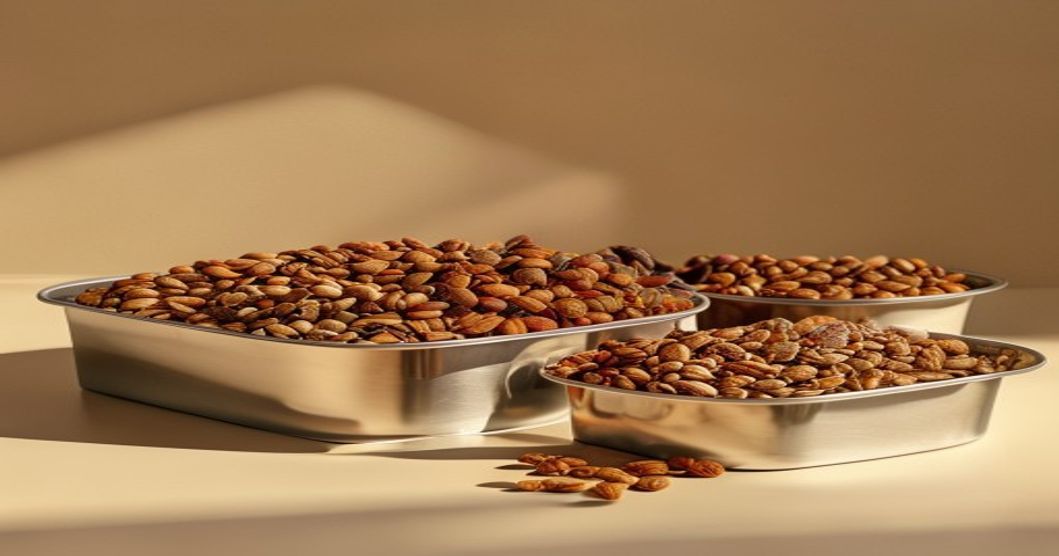
Foodservice snack buying is not retail snack buying at a larger size. The differences run deeper than the case count: the labelling regime changes the moment a product leaves its pack, the storage constraint is a back-of-house cupboard rather than a warehouse aisle, the cost metric is per serving rather than per kilogram, and the ordering rhythm follows occupancy and headcount rather than a planogram reset.
Buyers who arrive from retail carry retail assumptions and get caught by the same three things: they specify a pack that nobody in the venue can actually store, they under-plan the allergen information that a decanted product legally requires, and they set an order cadence built on a forecast when the operation runs on a consumption pattern. This guide works through each of those, along with the format decisions that drive them.
Who "foodservice" actually is
The label covers operations with materially different constraints. Getting the sub-channel right before specifying anything saves a sampling round.
| Sub-channel | Typical snack role | Dominant constraint |
|---|---|---|
| Hotels | Breakfast buffet, minibar, lounge, conference catering, in-room amenity | Presentation and brand consistency; very limited storage per outlet |
| Restaurants and cafés | Counter display, side item, kitchen ingredient | Kitchen humidity and speed of turnover |
| Contract catering | Staff restaurants, hospital and school feeding | Allergen documentation and audit trail; tendered pricing structures |
| Workplace pantry and micro-market | Free or subsidised snack provision, meeting rooms | Consumption unpredictability; portion drift |
| Vending | Single-serve only | Pack rigidity, drop tolerance, machine spiral fit |
| Travel catering | Tray sets, lounges | Fixed weight per unit, long qualification lead times |
| Events and conferences | Break stations, delegate bags | Extreme demand peaks against fixed dates |
A trail mix that works beautifully in a workplace pantry will fail in a vending machine if the pouch collapses, and a bulk case that suits a contract caterer is unusable in a boutique hotel with one shelf of dry storage. Specify the sub-channel first.
Pack formats and what each one costs you
There are five formats in practical use, and the choice determines labelling obligations, waste, handling time and cost per serving simultaneously.
Bulk case for decanting. Product in food-grade liners inside a case, opened at the venue and transferred to bowls, dispensers or portion cups. Lowest packaging cost per kilogram, lowest packaging waste, highest labour, and the format that triggers the allergen obligations discussed below. Requires a resealable liner or the venue will lose the second half of every case to moisture.
Single-serve sachet or portion pack. A fixed gram weight per unit. Highest packaging cost and highest packaging waste per kilogram of product, and by a wide margin the easiest to control, count and hand over. Also the only format that survives vending and travel catering.
Grab-and-go retail-style pouch. A retail pack sold or provided in a foodservice setting — hotel lounge, café counter, micro-market. Carries full retail labelling and can be branded, which matters when the venue wants the snack to look like an offer rather than a supply.
Dispenser-fill format. Bulk product intended for gravity or scoop dispensers. Sits between the first two: less labour than bowl service, less packaging than sachets, but the dispenser itself becomes a hygiene and allergen control point.
Kitchen ingredient bulk. Dried fruit, nuts and botanicals bought to be used in preparation rather than served as a snack. Specified by particle size and functional behaviour, not by consumer appeal.
| Format | Packaging cost per kg | Labour at venue | Portion control | Waste risk | Labelling regime |
|---|---|---|---|---|---|
| Bulk case, decanted | Lowest | Highest | Weakest | Moisture and over-portioning | Allergen info must be provided by the operator |
| Single-serve sachet | Highest | Lowest | Strongest | Packaging volume | Prepacked rules apply |
| Retail-style pouch | High | Low | Good | Slow-moving stock reaching date | Full retail labelling |
| Dispenser fill | Low | Medium | Medium | Cross-contact at the dispenser | Allergen info at point of service |
| Kitchen ingredient bulk | Lowest | Varies | Not applicable | Opened-case shelf life | Information transfers to the prepared dish |
The comparison most buyers get wrong is the first two. Sachets look expensive on a per-kilogram basis and frequently work out cheaper per serving once portion drift, decanting labour and end-of-day waste are counted. Run that arithmetic before deciding on price per kilogram alone.
The labelling difference nobody plans for
This is the point at which foodservice genuinely diverges from retail, and it is worth understanding precisely.
Under the Food Information to Consumers Regulation (EU) No 1169/2011, prepacked food carries the familiar full set of mandatory particulars: name, ingredient list, allergens emphasised, net quantity, durability date, storage conditions, operator details and a nutrition declaration. A sealed single-serve sachet handed to a guest is prepacked. So is a retail pouch on a counter.
Food that is not prepacked — sold loose, or packed at the request of the purchaser, or prepacked for direct sale on the premises — falls under a different provision. For that food, allergen information remains mandatory; the other particulars are subject to national rules, which differ between member states in whether they must be written, how, and where.
The moment a bulk case is opened and its contents go into a bowl, the product is no longer prepacked, and the venue operator becomes responsible for providing allergen information about it. That obligation cannot be met unless the information travelled with the goods. Which means the buyer's job is to ensure it does.
Three practical requirements follow:
- Get allergen data in a transferable form. Not only printed on the outer case, but as a specification document the operator's team can use to populate a menu system, an allergen matrix or a buffet card. Ask for it as data, not as a photograph of a label.
- Include cross-contact statements and their basis. "May contain" statements are not decorative; they reflect the supplier's line reality. The operator needs to know whether a statement reflects an assessed risk or a blanket precaution, because a blanket precaution applied across a menu makes the menu unusable for the guests it is meant to protect.
- Keep the information current across reformulations. A recipe change at the supplier that is invisible on the outer case can silently invalidate every allergen card in a catering operation. Contract for notification of change, in writing, with a lead time.
Bulk cases supplied for professional use still need their commercial documentation — identification, lot, durability, storage conditions, operator details — and the buyer should treat that documentation as part of the specification rather than as paperwork that arrives with the pallet.
Portion control and the cost metric that matters
Retail thinks in pack price. Foodservice thinks in cost per serving, and the two diverge because of portion drift.
A snack decanted into an open bowl is portioned by hand, by guests, and by whoever refills it. Consumption per head under bowl service is routinely and substantially higher than the nominal portion used to build the budget, and the variance is wider than the average is high — which is what makes it hard to forecast rather than merely expensive.
Three levers control it:
- Vessel size. A smaller bowl refilled more often produces lower total consumption than a large bowl filled once, for the same total availability. It costs labour.
- Portion tools. Scoops and cups sized to the intended serving move the default without removing choice.
- Unit packaging. A sachet removes drift entirely and converts a variable cost into a fixed one. This is why workplace and conference programmes so often migrate to single-serve after a year of bowl service, despite the packaging cost.
Build the budget on cost per serving at the observed consumption rate, not the intended one. If you do not yet know the observed rate, run bowl service for a defined trial period and count refills before committing to an annual volume.
Composition matters here too: a mix with expensive components will be picked over, and the fraction left in the bowl at the end of service is the cheap part. Blends intended for open service are formulated differently from blends intended for sealed packs, which is a conversation to have at recipe stage; the custom blend sourcing guide covers how component ratios are set and costed.
Storage, handling and the venue reality
Dry storage in a hotel or restaurant is measured in shelves, not pallets. This has direct consequences for what to specify.
Case cube and stackability. A case that does not fit the shelf gets decanted into an unlabelled container on day one, which destroys traceability and allergen control at a stroke. Ask for case dimensions before ordering, and check them against the actual storage, not the loading bay.
Humidity. Kitchens are humid. Dried, crisp products are hygroscopic and will soften quickly in an opened case that cannot be resealed. Specify a resealable liner or a clip, and set an opened-case use-by period in the specification rather than leaving it to judgement.
Date rotation. Foodservice operations run FIFO in principle and rarely in practice under pressure. Clear date printing on the case, in a position visible when the case is shelved, does more for rotation compliance than any procedure.
Delivery consolidation. Most venues receive from several suppliers on constrained delivery windows. Consolidating snack lines into fewer deliveries reduces the reception burden, and reception time is a real cost in an operation running a tight rota. Where goods are imported, the delivery term determines who controls the final leg and who absorbs a delay; the Incoterms guide sets out the options.
Ordering cadence
Retail replenishes against a forecast tied to a planogram. Foodservice replenishes against consumption that follows occupancy, headcount and the calendar — hotel seasonality, school terms, conference cycles, the collapse of workplace consumption in August.
A working cadence has four parameters:
- Par level per venue, expressed in servings rather than cases, so that venues of different sizes can be managed on one system.
- Reorder point, set at par minus expected consumption over the supplier lead time, plus a buffer sized to the reliability of that lead time rather than to anxiety.
- Order multiple, which is where supplier MOQ meets venue storage. A minimum order that exceeds a venue's storage capacity forces central warehousing, and that cost belongs in the comparison.
- Review frequency, weekly for high-turnover lines, monthly for the long tail.
The tension specific to this channel is between MOQ and storage. A supplier minimum that is comfortable for a central distribution centre is impossible for a twelve-room boutique hotel, and the answer is usually a distributor holding stock between the two — at a margin that has to be earned by the service. Direct supply makes sense above the volume where you can hold your own buffer. The financing side of holding that buffer is covered in the payment terms and trade finance guide.
For long-lead imported product, plan reorders against the full production plus transit window rather than the transit window alone. The most common stock-out in this channel is a Q4 shortage ordered in October.
What differs from retail, summarised
| Dimension | Retail | Foodservice |
|---|---|---|
| Cost metric | Price per pack, margin per facing | Cost per serving delivered |
| Labelling | Full prepacked particulars | Depends on format; allergen information obligatory once decanted |
| Pack driver | Shelf impact and shopper appeal | Storage footprint, resealability, handling time |
| Demand signal | Sell-through against a planogram | Occupancy, headcount, event calendar |
| Storage | Warehouse and shelf | A back-of-house cupboard |
| Change cost | Artwork and listing cycle | Retraining and allergen documentation update |
| Order size | Forecast-driven bulk | Par-level replenishment with hard storage limits |
Buyers serving both channels from one supply base should expect two specifications, not one product in two case sizes. The wider category view sits in the wholesale natural snacks guide, and the operational detail of bulk supply into hospitality in the HORECA bulk sourcing guide.
Where Arovela fits
We supply dried fruit, botanicals and herbal tea from a processing site at Sındırgı in Balıkesir, using geothermal heat in the drying stage, with a warehouse at Solingen serving European customers. Management systems are certified to ISO 22000, ISO 9001 and ISO 27001, and specification and allergen documentation is issued as data rather than as an image of a label.
For this channel the relevant capabilities are bulk dried fruit and botanical supply in food-grade cases, private label packing into pouches and portion formats, and tea bags. Tea is a foodservice staple and format choice matters: individually enveloped bags are what hotel and conference settings usually want, because the envelope protects aroma on an open tray and looks intentional; string-and-tag bags suit table and lounge service; plain single-chamber bags suit high-turnover back-of-house use. The three are compared in the tea bag formats guide. Our line runs at approximately 1,000 bags per hour, with production tiers of 5,000–20,000 bags in 2–4 weeks and 50,000–100,000 bags in 4–6 weeks from approved recipe and artwork — the reasoning behind those tiers is in the MOQ and lead time guide.
What we do not run: vending-qualified rigid packaging, and travel catering formats with their own qualification protocols. Pouch and portion formats for pantry, buffet and counter use are within what we pack; the format options are set out in the retail packaging guide. Programmes aimed specifically at office and staff provision are covered in the workplace snack programme guide.
FAQ
What is the best snack pack format for a hotel breakfast buffet?
Usually a bulk case decanted into portioned vessels, with the allergen information available at the buffet. It gives the lowest cost per serving and the presentation hotels want. Budget for the labour and for an opened-case use-by rule, and specify a resealable liner so the second half of the case does not soften.
Do I need full labelling on bulk cases supplied to a caterer?
The case needs its commercial identification, lot, durability date, storage conditions and operator details. Once the contents are served loose, the operator must provide allergen information to the guest, and they can only do that if you supplied it in a usable form. Treat the allergen specification as a deliverable, not as an attachment.
Why is my cost per serving higher than the price per kilogram suggested?
Portion drift under open service, plus product left at the end of service, plus decanting labour. Bowl service consumption commonly exceeds the nominal portion used to build the budget. Measure refills over a trial period, then decide between smaller vessels, portion tools or single-serve packs.
How should ordering frequency be set for a multi-site operation?
Set par levels in servings per site, calculate a reorder point from the supplier lead time plus a buffer sized to that lead time's reliability, and review high-turnover lines weekly. Where a supplier minimum exceeds a site's storage capacity, either consolidate through a central buffer or accept a distributor between you and the manufacturer.
Can foodservice packs and retail packs come from the same production run?
The product can be identical; the packaging, labelling and documentation are not. Plan them as two specifications sharing a recipe. Running both from one production run is efficient, but the artwork, case configuration and allergen documentation have to be prepared separately, and that preparation is what determines the timeline.
Sizing a snack or tea programme for hotels, catering or workplace supply? Send the sub-channel, the pack format, the number of sites and your expected servings per week, and request a quote — we will tell you which formats we pack and where a specialist supplier serves you better.