Key takeaways
- Laurel berry oil is a fixed (fatty) oil pressed from the ripe berries of Laurus nobilis — rich in lauric, oleic, and linoleic acids. It is the defining ingredient of traditional Aleppo soap, and it should never be confused with steam-distilled laurel leaf essential oil.
- Türkiye is a primary world source. The bay laurel tree grows wild and semi-wild across the country's coastal belt, with the Hatay region in the south recognised as a leading origin for laurel berries and leaves. Türkiye accounts for the large majority of internationally traded laurel.
- For B2B buyers — soap-makers, natural-skincare brands, and cosmetic formulators — the two product streams differ in extraction, chemistry, regulatory handling, MOQ, and price. This guide separates them clearly.
- Always request a batch Certificate of Analysis (COA) covering fatty-acid profile (for berry oil) or GC-MS volatile profile (for leaf essential oil), plus heavy metals, peroxide value, and an INCI-correct label.
- Arovela supplies from a Sındırgı (Balıkesir) facility with a warehouse in Solingen, Germany, giving EU buyers short lead times. Our quality system runs on ISO 22000, ISO 9001, and ISO 27001 documentation with a COA available on request.
Introduction: why laurel berry oil is back on procurement lists
Laurel berry oil has been used around the eastern Mediterranean for skin and hair care for centuries, and it is best known today as the heart of Aleppo soap — the hard, olive-and-laurel bar that natural-cosmetics brands have rediscovered over the last decade. As clean-label and "traditional formula" positioning has grown across European and Gulf retail, demand for authentic, well-documented laurel berry oil has followed.
For a procurement manager or a cosmetic formulator, the challenge is rarely "can I find laurel oil" — it is "can I find the right laurel oil, with paperwork I can put in front of an EU Responsible Person." The market is full of two completely different products both casually sold as "laurel oil," and buying the wrong one is an expensive mistake.
This guide is written for B2B buyers sourcing from Türkiye. It explains what laurel berry oil actually is, how it differs from laurel leaf essential oil, which quality documents to demand, what realistic MOQ and pricing look like, and how origin and certification affect the decision. If you already source botanicals from Türkiye, this is a natural extension of an existing supplier relationship; if you are new to Turkish sourcing, start with our essential oils B2B sourcing guide for the category fundamentals.
Laurel berry oil vs laurel leaf essential oil: the distinction that matters
This is the single most important thing to get right before you place an order. The bay laurel tree (Laurus nobilis) yields two entirely different commercial oils, and they are not interchangeable.
Laurel berry oil — a fixed (fatty) oil
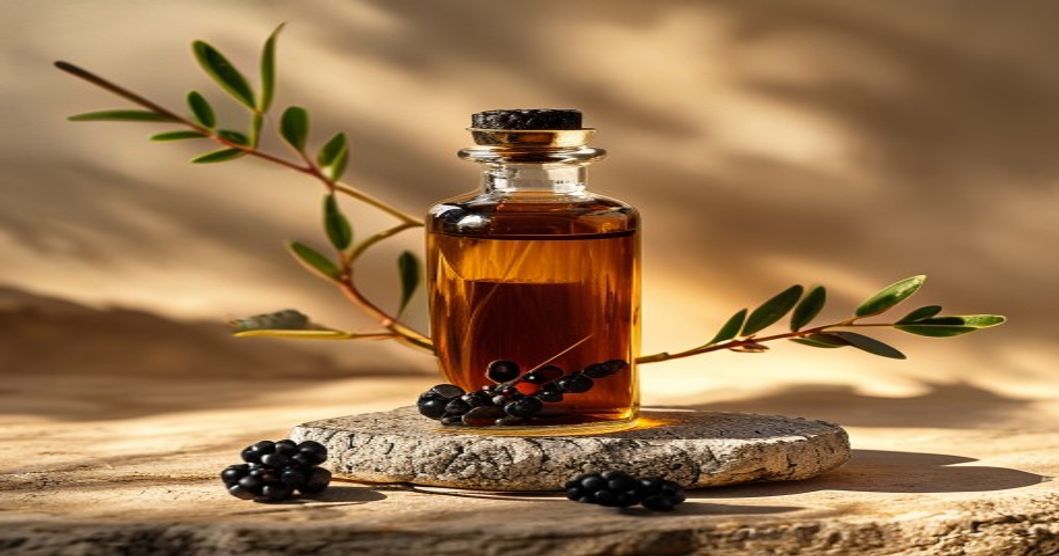
Laurel berry oil is a fixed oil, also called a fatty or carrier oil. It is obtained from the ripe black berries of the laurel tree, traditionally by boiling the crushed berries in water and skimming the oil that rises, and in modern production by cold pressing or solvent-free expression. The result is a thick, dark-green, intensely aromatic oil.
Chemically it is a triglyceride oil dominated by fatty acids — depending on origin and extraction method, the profile is rich in lauric, oleic, and linoleic acids (published analyses report lauric acid anywhere from roughly 9% to over 50%, with oleic and linoleic each commonly in the 15–40% range). Lauric acid contributes the antimicrobial, lathering character prized in soap; oleic acid (omega-9) gives emolliency; linoleic acid (omega-6) supports the skin barrier. This is why it behaves like a soap-making and skincare base oil rather than a fragrance.
Primary uses: Aleppo-style and artisan soap, balms, salves, scalp and hair oils, traditional skincare. In INCI it appears as Laurus Nobilis Fruit Oil.
Laurel leaf essential oil — a steam-distilled volatile oil
Laurel leaf essential oil (often sold as "bay laurel" or "laurel leaf oil") is a completely different category. It is steam-distilled from the fresh leaves and young branchlets, and it is a volatile aromatic oil, not a fatty one. Its chemistry is dominated by 1,8-cineole (eucalyptol) — typically 40–65% of the oil — alongside α-terpinyl acetate, sabinene, linalool, and the pinenes. Turkish leaf-oil yields run roughly 1.4–2.6% on a dry-weight basis.
Primary uses: aromatherapy, fragrance and perfumery, fine-fragrance and functional-fragrance blends, and as a flavour note. In INCI it appears as Laurus Nobilis Leaf Oil.
Side-by-side comparison
| Attribute | Laurel berry oil (fixed) | Laurel leaf essential oil (volatile) |
|---|---|---|
| Plant part | Ripe berries (fruit) | Fresh leaves / young branchlets |
| Extraction | Boiling/skimming or cold press | Steam distillation |
| Oil type | Fixed / fatty (triglyceride) | Volatile essential oil |
| Key constituents | Lauric, oleic, linoleic acids | 1,8-cineole (eucalyptol), α-terpinyl acetate, sabinene |
| Appearance | Thick, dark green, semi-solid in cold | Pale yellow, free-flowing liquid |
| INCI name | Laurus Nobilis Fruit Oil | Laurus Nobilis Leaf Oil |
| Typical applications | Soap, balms, hair & skin care | Aromatherapy, fragrance, flavour |
| Key COA metric | Fatty-acid profile, peroxide value | GC-MS volatile profile, 1,8-cineole % |
| Typical dosage | Up to high % as a base oil | Fraction of a % to low single digits |
If your formula is a soap or a leave-on skincare base, you almost certainly want the berry oil. If your formula is an aromatherapy or fragrance product dosed at a fraction of a percent, you want the leaf essential oil. Confusing the two is the most common — and most costly — sourcing error in this category.
Why source laurel from Türkiye?
Türkiye as a primary world origin
The bay laurel tree is native to the Mediterranean basin, and Türkiye is one of its natural heartlands. Laurus nobilis grows wild and semi-wild along the entire coastal arc — from the Mediterranean south up to the Eastern Black Sea — and Türkiye is consistently the dominant exporter of laurel leaves worldwide, supplying the large majority of internationally traded volume to dozens of countries.
The Hatay region in southern Türkiye is particularly associated with high-quality laurel. The trees there are largely wild-harvested, with local families collecting berries each autumn and leaves through the season, exactly as they have for generations. This semi-wildcrafted supply chain is part of what makes Turkish laurel attractive: it is genuinely traditional, not plantation-industrial.
Origin and chemistry are linked
For leaf essential oil, geography measurably affects chemistry. Comparative studies of laurel from different parts of Hatay show 1,8-cineole varying by collection site — for example, oil from coastal Samandağ measured around 60% cineole. For a formulator, this is why you specify a target cineole range on the purchase order and verify it on the GC-MS report, rather than assuming all "Turkish laurel leaf oil" is identical. Our guide on how to read a GC-MS report for essential oils walks through exactly which peaks to check.
For berry oil, origin and ripeness at harvest affect the fatty-acid balance and the depth of colour and aroma — which is why a fatty-acid profile on the COA is non-negotiable for serious buyers.
Logistics: Türkiye plus a German warehouse
Arovela operates from a Sındırgı (Balıkesir) facility and holds stock in a warehouse in Solingen, Germany. For EU-based soap-makers and skincare brands, the German node matters: it shortens lead times, simplifies intra-EU shipping, and reduces the customs friction of importing directly from outside the bloc for every order. For the broader picture of buying botanicals from Turkish origin, see our essential oils wholesale Türkiye supplier guide.
Quality documentation: what to request before you buy
A reputable B2B supplier should provide a full document pack per batch. This is where many low-cost offers fall down, and it is the part EU and Gulf buyers cannot skip.
Certificate of Analysis (COA) — per batch, not per product
Insist on a batch-specific COA, tied to the exact lot number you are buying. For each oil type the relevant parameters differ:
For laurel berry (fixed) oil:
- Fatty-acid composition (lauric / oleic / linoleic and minor acids)
- Peroxide value and acid value (rancidity indicators)
- Saponification and iodine values
- Heavy metals (lead, arsenic, cadmium, mercury)
- Appearance, odour, and relative density
For laurel leaf essential oil:
- Full GC-MS volatile profile with 1,8-cineole percentage
- Refractive index, specific gravity, optical rotation
- Heavy metals and, where required, pesticide residues
Regulatory and trade documents
| Document | What it confirms | Who asks for it |
|---|---|---|
| Batch COA | Identity, purity, key chemistry | All cosmetic buyers |
| Safety Data Sheet (SDS) | Hazard, handling, storage | All importers |
| INCI / labelling sheet | Correct INCI name for the label | Formulators, RPs |
| Allergen / IFRA statement | Fragrance-allergen content | Fragrance & retail buyers |
| Country of origin / phytosanitary | Origin (Türkiye) and plant health | Customs / importers |
| Specification sheet | Agreed grade and tolerances | Procurement |
A note on cosmetic compliance and "organic" claims
If your finished product is sold in the EU, it must comply with the EU Cosmetics Regulation (EC) No 1223/2009, including a safety assessment and a designated Responsible Person. Buyers frequently also ask suppliers about COSMOS, ECOCERT, organic, GMP, halal, or kosher status, because their own brand positioning may require it.
Be precise about what a supplier actually holds. Arovela's certifications are ISO 22000, ISO 9001, and ISO 27001. We provide a COA on request and the trade documentation above; we do not claim COSMOS/ECOCERT/organic/GMP/halal/kosher certification. If your specification requires one of those scheme certificates, raise it during qualification so the right sourcing route can be confirmed rather than assumed.
MOQ, pricing, and formats — what to expect
Pricing for laurel oil swings widely with crop year, harvest yield, extraction method, and order volume, so treat any figure as indicative and confirm a current quote against your specification. As a directional guide:
| Product | Typical format | Indicative MOQ | Price driver |
|---|---|---|---|
| Laurel berry oil (standard) | Drum / jerrycan, bulk | Low — single-digit kg to start, scaling to drums | Crop year, lauric content, colour |
| Laurel berry oil (premium, traditional press) | Jerrycan, bulk | Low–moderate | Extraction method, origin grade |
| Laurel leaf essential oil | Aluminium bottle / drum | Low — sample-friendly | 1,8-cineole %, distillation quality |
| Private-label / custom spec | Agreed packaging | By agreement | Spec complexity, packaging, COA scope |
Berry oil is sold by weight as a base/fatty oil and is generally far more affordable per kilogram than the steam-distilled leaf essential oil, which is priced as a concentrated aromatic and used at a fraction of the dosage. Premium "traditional press" berry oil — darker, more aromatic, higher in the prized fatty acids — sits above commodity berry oil.
For first orders, request a sample with the COA attached (samples are free of charge; you cover the courier) so your lab or formulator can verify the chemistry against your spec before you commit to a drum. Confirm packaging (food/cosmetic-grade, light-protective), Incoterms, and whether stock can ship from the Solingen warehouse for faster EU delivery. Current grades, formats, and quote requests are handled through our wholesale page.
Formulation notes for soap-makers and skincare brands
In cold-process and Aleppo-style soap
Laurel berry oil is added to an olive-oil soap base; the lauric-acid fraction contributes cleansing and a firmer bar, while the oleic and linoleic acids keep it conditioning. Traditional Aleppo bars use laurel oil at a meaningful percentage of the oil phase — higher laurel content is marketed as a premium tier. Because the oil is dark green and strongly scented, it also colours and perfumes the bar naturally.
In leave-on skincare and hair care
In balms, scalp oils, and hair treatments, berry oil is valued for its emollient feel and traditional reputation. As always under EC 1223/2009, the finished product must carry a safety assessment; the fact that an ingredient is "natural" or "traditional" does not exempt the formula from the regulatory dossier.
When you actually want the leaf oil
If your brief is a fragrance, a functional aromatherapy product, or a flavour application, switch to laurel leaf essential oil and dose it as a potent aromatic — typically a fraction of a percent up to low single digits, within IFRA limits for fragrance uses.
Frequently asked questions
What is laurel berry oil?
Laurel berry oil is a fixed (fatty) oil obtained from the ripe berries of the bay laurel tree, Laurus nobilis. Traditionally made by boiling and skimming the crushed berries, and in modern production by cold pressing, it is a thick, dark-green oil rich in lauric, oleic, and linoleic acids. It is the signature ingredient of Aleppo soap and is used across natural soap, balm, skincare, and hair-care formulas. Its INCI name is Laurus Nobilis Fruit Oil.
What is laurel berry oil used for?
Mainly soap-making — especially Aleppo-style and artisan bars — where it adds cleansing, a firmer bar, and a natural green colour and scent. Beyond soap it is used in balms, salves, scalp and hair oils, and traditional leave-on skincare, where its oleic- and linoleic-acid content makes it a conditioning base oil.
How is laurel berry oil different from laurel essential oil?
They come from the same tree but are different products. Berry oil is a fixed/fatty oil pressed from the fruit, dominated by fatty acids (lauric, oleic, linoleic), and used as a base oil in soap and skincare. Leaf essential oil is steam-distilled from the leaves, dominated by volatile 1,8-cineole (eucalyptol), and used in tiny doses for aromatherapy, fragrance, and flavour. Buying the wrong one is the most common sourcing mistake — match the oil type to your formula.
Where can I buy laurel berry oil in bulk?
Türkiye is a primary world origin, with the Hatay region recognised for quality wild-harvested laurel, so sourcing from a Turkish B2B supplier is the natural route. Arovela supplies laurel oil with a COA on request from a Sındırgı (Balıkesir) facility, with stock held in a Solingen, Germany warehouse for short EU lead times. You can request grades, samples, and a quote through our wholesale page or by contacting our team directly.
What is the typical price range for laurel berry oil?
It varies significantly by crop year, extraction method, lauric content, and order volume, so always confirm a current quote against your specification. As a directional note, berry oil is sold by weight as a base oil and is generally far cheaper per kilogram than the steam-distilled leaf essential oil; premium "traditional press" berry oil commands a higher price than commodity grade. Request a sample with COA (samples are free of charge; you cover the courier) to verify chemistry before committing to a drum.
What quality documents and COA should I request?
Always require a batch-specific Certificate of Analysis tied to your lot. For berry oil, that means a fatty-acid profile, peroxide and acid values, saponification/iodine values, and heavy metals. For leaf essential oil, require a full GC-MS volatile profile with the 1,8-cineole percentage plus physical constants. Alongside the COA, ask for an SDS, an INCI/labelling sheet, an allergen/IFRA statement, and country-of-origin documentation. If your brand needs a specific scheme certificate (COSMOS, ECOCERT, organic, etc.), confirm it explicitly during supplier qualification.
Source laurel berry oil with documentation that ships
Authentic Laurus nobilis laurel berry oil from a primary world origin, with the right INCI label and a batch COA you can hand to your Responsible Person, is the difference between a clean qualification and a stalled launch. Arovela supplies from a Sındırgı (Balıkesir) facility with a Solingen, Germany warehouse for short EU lead times, backed by ISO 22000, ISO 9001, and ISO 27001 documentation and a COA on request.
Tell us your formula, your target spec, and your destination market, and we will match the right laurel oil — berry or leaf — and the paperwork to go with it. Contact the Arovela team to request a sample and a quote.